
Agentstration has reached its third public alpha. The theme of this edition is not simply “more resources” or “more screens.” It is the path between them: how a capability is scoped, discovered, composed, executed, and observed without dissolving the platform’s governance boundaries.
This remains an alpha for local evaluation and contributor feedback. The release is not intended for production deployment, and a fresh data directory or empty database is required when moving from the previous alpha.
Watch the release
- Agentstration in 90 seconds — a concise introduction to the platform and its purpose.
- The three major new features — Microsoft Foundry, composed Flows, and governed capabilities exposed through the internal MCP server.
In this edition
- What this release enables today
- Every resource now has an explicit scope
- Distributing official and community resources
- Flows become building blocks
- The Console becomes an interaction surface
- AEP becomes an authenticated boundary
- What to keep in mind for this alpha
What this release enables today
- Discover an exact Source version from an official, community, or private registry, inspect its evidence, and import it with retained provenance.
- Choose whether a resource belongs to the Instance, a Tenant, or a Workspace so its visibility and reuse remain intentional.
- Build a Flow that calls another published Flow and governed Tools while keeping a durable execution trail.
- Expose enabled Workspace Tool Definitions and selected internal Tools through an authenticated internal MCP endpoint.
- Start or resume Entry-backed conversations directly from the operations Console.
- Discover the models offered by a provider together with their declared capabilities before selecting them in a Model Profile.
- Connect existing Microsoft Foundry deployments as governed Model Providers through the optional AEP extension.
- Enroll out-of-process AEP extensions with dedicated credentials and connect an extension’s configuration requirements to Parameters and Secrets that are resolved only when used.
Every resource now has an explicit scope
Management resources now state where they belong. An Instance-scoped resource represents a capability shared by the platform. A Tenant-scoped resource can be shared across an organization. A Workspace-scoped resource stays attached to the working context that owns it.
This makes it possible to place configuration at the right level instead of duplicating it or making it implicitly global. A Provider, Parameter, extension, or another governed resource can be administered in its natural context, while every operation continues to be evaluated with the current Tenant, Workspace, and Principal permissions.
Hierarchical visibility does not mean that every parent resource is automatically usable by its descendants. Vaults and Secrets default to denying descendant use: a Tenant or Workspace must receive an explicit grant. The same separation prevents an extension from choosing its own scope during enrollment; that decision belongs to an administrator.
Under the hood
- Scope is part of resource identity and requests; it is not inferred from a name or from the screen where the resource is used.
- Resource-kind policies determine which scopes are valid and whether descendant visibility is allowed.
- Permissions are checked when the resource is actually used, not only when it is created.
Distributing official and community resources
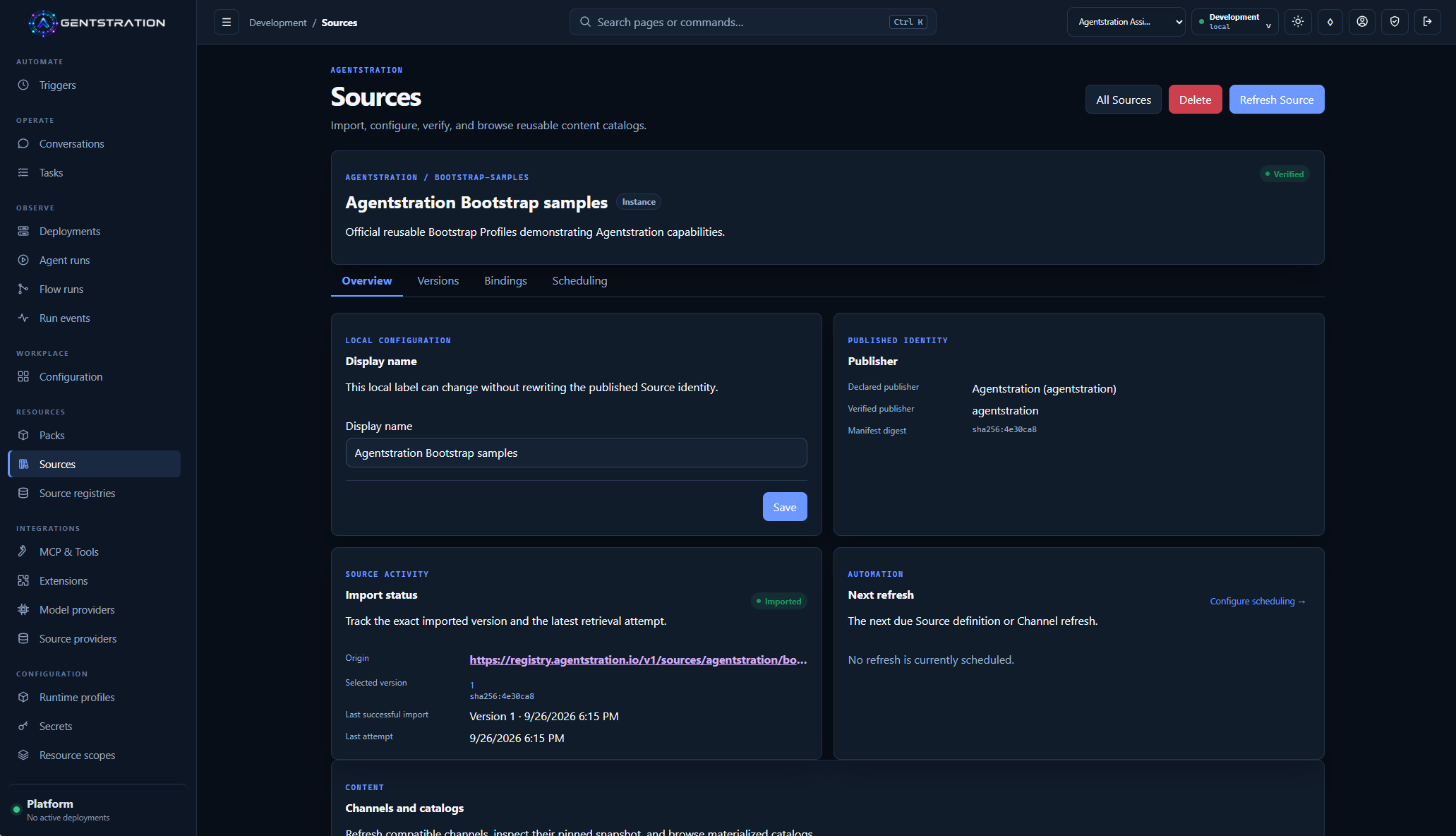
Agentstration introduces a common mechanism for distributing resources published by the official project, the community, or a private catalog. The goal is to let an administrator discover a collection of resources, select the intended version, and import it into the platform without relying on manually exchanged archives.
This first implementation uses Git. A Source describes the content to distribute, while a Channel follows a branch or reference and resolves it to an immutable commit when materialized. Packs in the resulting catalog can then be installed as ordinary Agentstration resources.
The official registry provides the first discovery point. Community and private registries can be added separately and remain under administrator control. Every import retains its provenance, version, and evidence so that the origin of the content remains visible after it enters the platform.
Under the hood
- Registry refresh is explicit or opt-in scheduled, retains a last-known-good observation, and does not make startup depend on the network.
- Trust is evaluated as separate evidence dimensions; a trusted registry does not automatically verify a publisher, Source version, or mutable Channel snapshot.
- The Source Registry .NET tool validates publications and computes canonical digests without requiring a running Agentstration instance.
Flows become building blocks
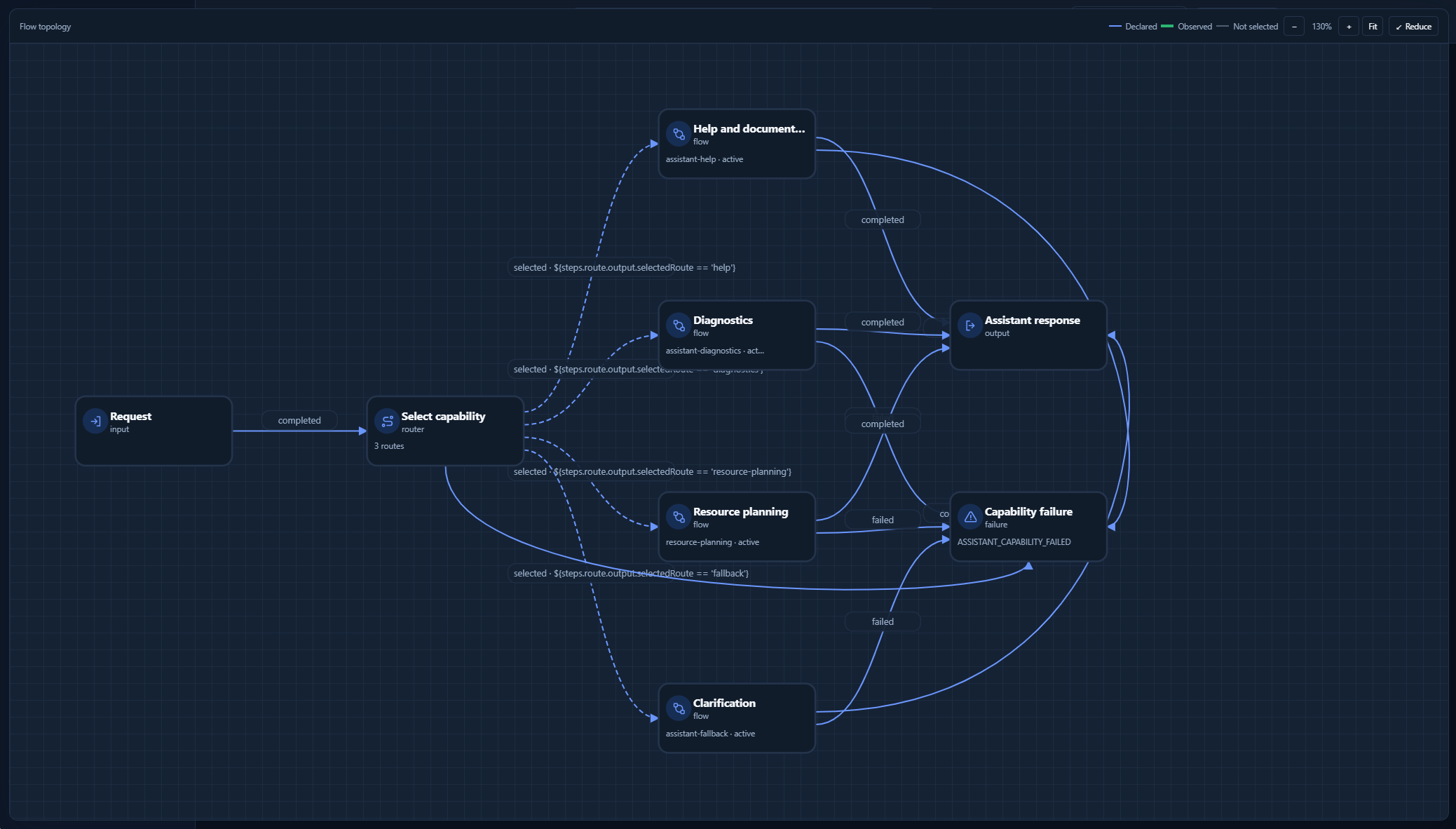
A complex orchestration should not require copying an existing graph. A Flow can now call another published Flow and can invoke a governed Tool as ordinary steps. Authors select an active or exact child version, map its input, and continue from its declared output. The designer prevents dependency cycles before publication.
At runtime, the child receives its own durable Flow Run and remains linked to the parent. Cancellation, bounded nesting, version resolution, and causal diagnostics make the relationship visible instead of hiding it behind a model call. Governed Tool steps use the same enablement, approval, audit, and provider pipeline as tools assigned to Agents.
Governed capabilities through internal MCP
This composition model also powers more than the visual designer. Agentstration now exposes an authenticated internal MCP endpoint that publishes only enabled Workspace Tool Definitions and a bounded set of internal Tools. A Flow can therefore become a carefully scoped capability for an MCP client without exposing generic management operations or an unrestricted Flow launcher.
Under the hood
- Entry, Trigger, REST, MCP, Agent, and Console submissions share one durable root Flow boundary; nested calls use a distinct child-run boundary.
- Flow and Tool execution remains at least once. The release does not claim exactly-once external effects.
- The internal MCP server exposes governed capabilities through
tools/listandtools/call, not general Management CRUD.
The Console becomes an interaction surface
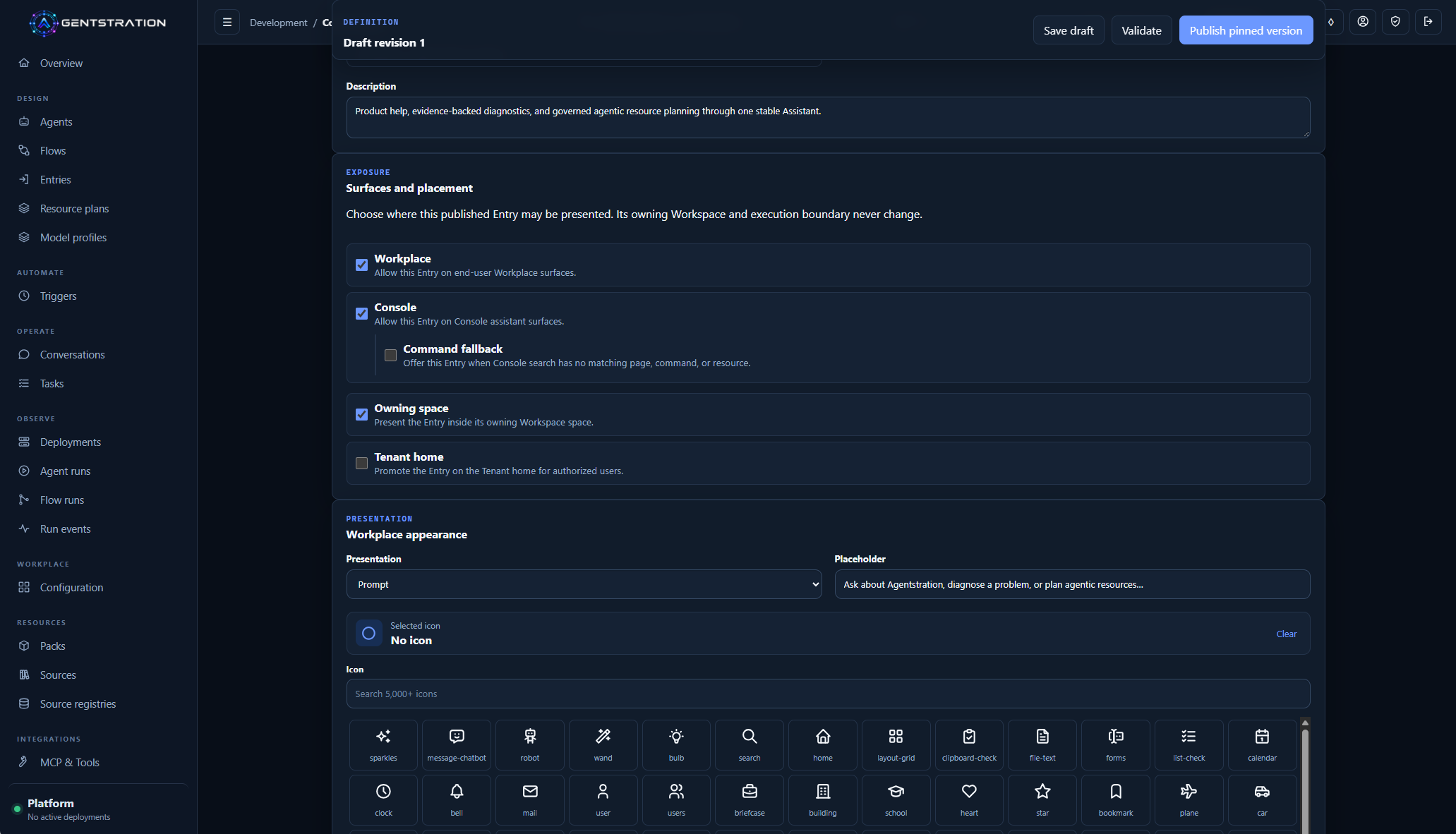
The Console is no longer limited to inspecting resources and execution. An Entry can now be exposed specifically in the Console and invoked from there with the same durable interaction model used by Workplace. Because every Entry targets a published Flow, teams can create Flows dedicated to administration: guided diagnostics, controlled operational procedures, or other internal capabilities that belong next to the resources they help manage.
These administrative Flows do not bypass the platform. Invocation still selects the Entry’s owning Workspace and follows the ordinary Work, Flow, authorization, Tool governance, and audit boundaries. An authorized fallback Entry may also be proposed when search finds no page, command, or resource, but the user must explicitly choose it before any work starts.
The Conversations view lists principal-owned interactions and can resume them without creating a parallel chat store. Operational users therefore get a direct path from the Console to a governed administrative capability while its execution record remains connected to the rest of the platform.
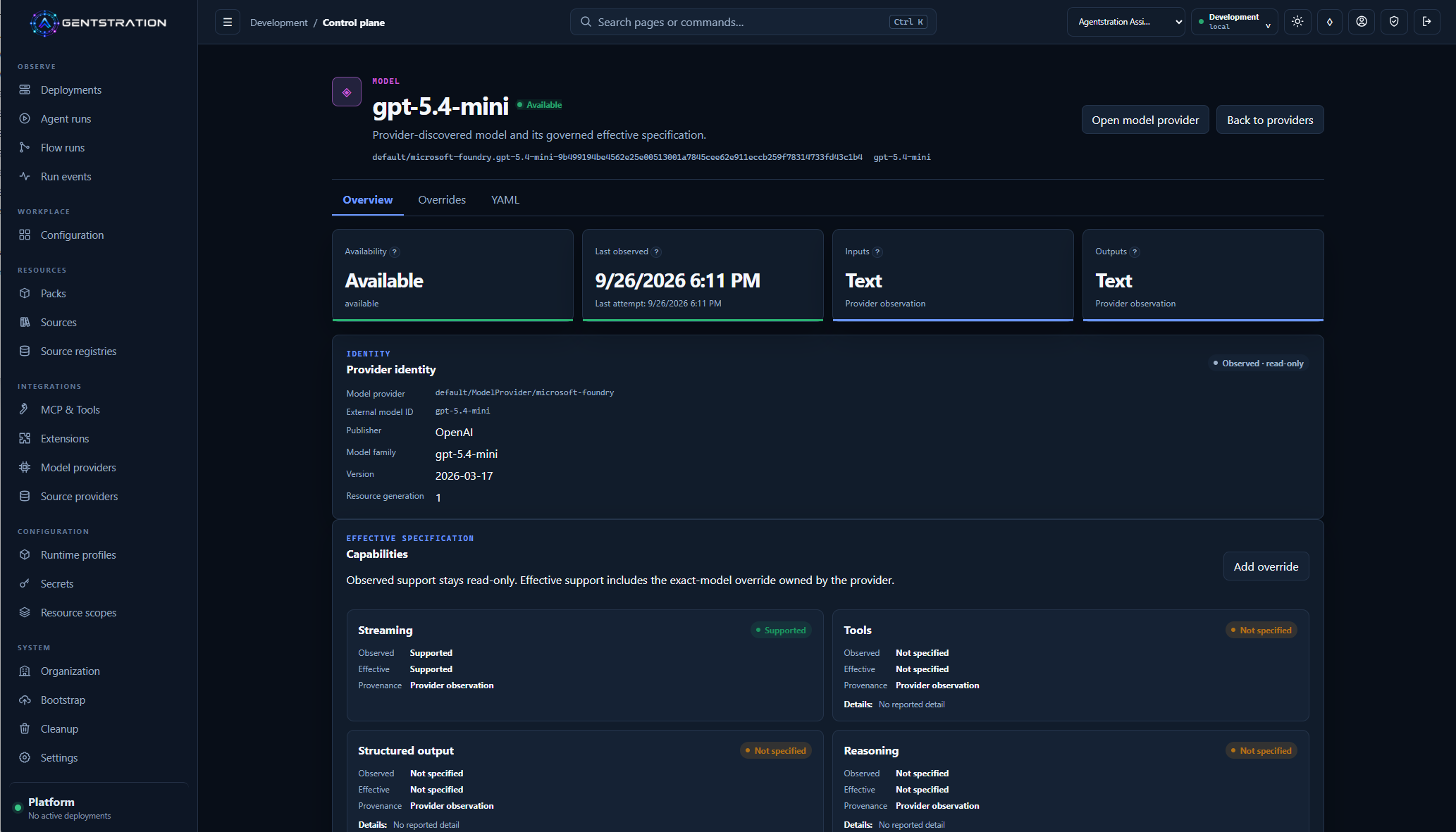
Provider discovery no longer retrieves only a list of model names. It also collects their declared capabilities: modalities, support for streaming, Tools, structured output or reasoning, and known limits when the provider supplies them. Every discovered model becomes a governed resource that an administrator can inspect before selecting it in a Model Profile.
Agentstration keeps provider observations, administrative overrides, and the effective capabilities resolved by the platform distinct. Compatibility checks can therefore use an explicit description of the model instead of relying on its identifier alone.
Tool Categories also make the catalog easier to navigate, while Agents retain explicit individual Tool references.
Under the hood
- Entry exposure selects Console and Workplace presentation independently; invocation always executes in the Entry owner’s Workspace.
- The Console now has an independently hostable BFF shell with opaque server-side sessions and short-lived API delegations; the all-in-one server remains the executable default.
- The standalone BFF uses an in-memory session store by default. Multiple replicas require a shared session-store implementation, and external OIDC login is not yet implemented.
- Model overrides may fill unknown information or tighten limits, but cannot turn an explicitly unsupported capability into a supported one.
AEP becomes an authenticated boundary
Agentstration Extension Protocol extensions are deliberately out of process. This release makes that separation an authenticated lifecycle rather than a configured URL alone. An extension can announce itself through a pairing code or SharedKeyFile; an administrator assigns its Instance, Tenant, or Workspace scope. Dedicated credentials can be rotated or revoked, and the unified Extensions experience shows enrollment, registration, availability, connection, and contributions together.
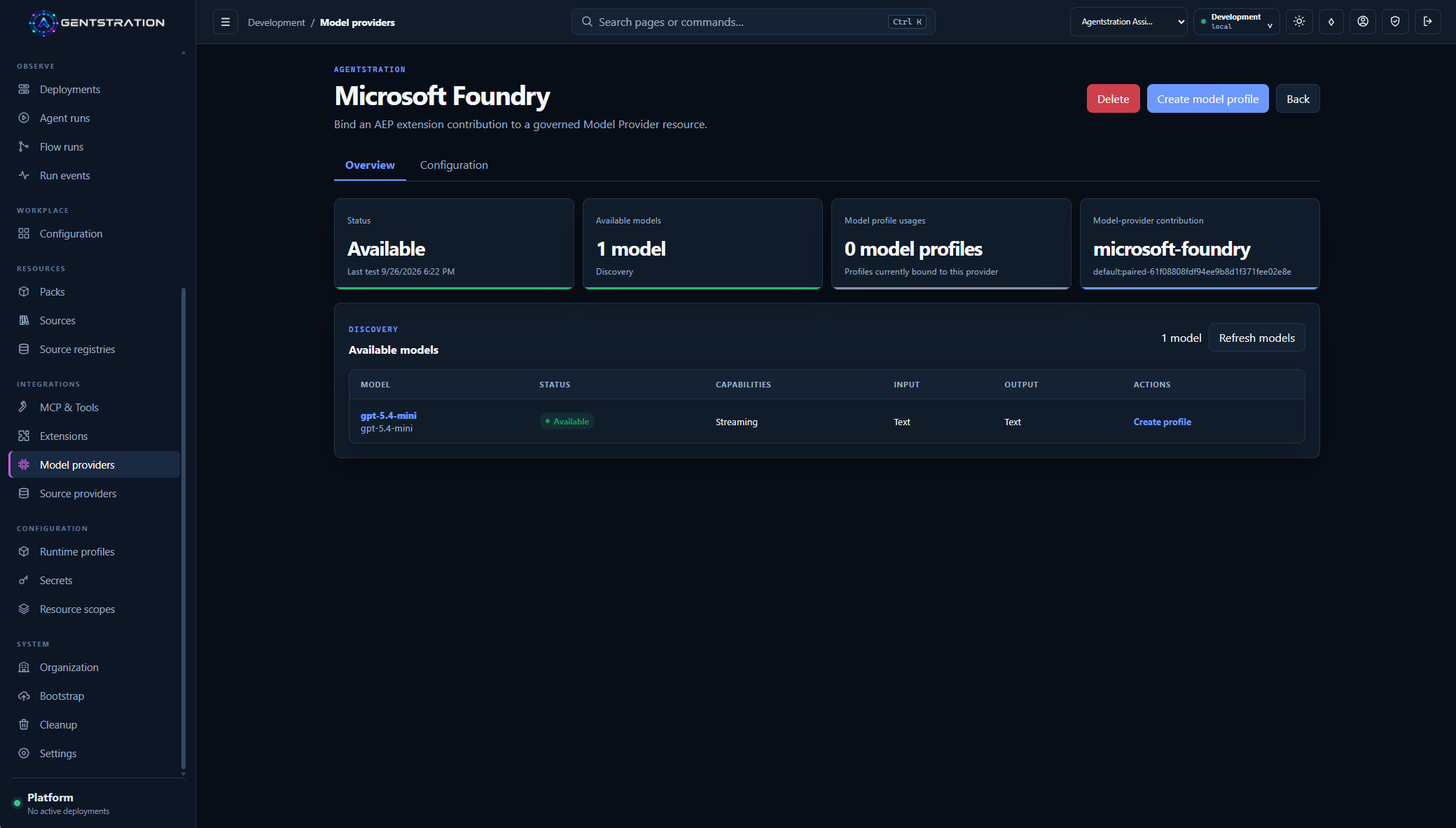
An extension can now declare the values required by each of its contributions. An administrator then binds those requirements to governed Parameters or Secrets at the appropriate scope. One extension process can therefore serve several independently configured Providers without turning their endpoints, authentication modes, or credentials into global process configuration.
Bindings are resolved late, when discovery, connection testing, or inference is performed. A Parameter edit, Secret rotation, or permission change therefore affects the next operation without copying the value into the Provider resource. When an extension needs a Secret, it receives a short-lived, one-use grant restricted to the exact context; the value does not appear in the resource, an ordinary response, or a trace.
The optional Microsoft Foundry extension is the clearest example of this boundary. It connects existing Foundry project deployments as Model Providers, supports model discovery, text chat, streaming, and governed Tool calls, and leaves Agentstration authoritative for Agents, profiles, revisions, and Tool governance. Azure remains optional: the deterministic SQLite path still runs without a cloud account or remote provider.
What to keep in mind for this alpha
There is no supported in-place migration from the previous alpha. Back up anything
that matters, then use a fresh data directory or empty database. A published build
does not create a default credential: use /bootstrap on the authoritative server
or an explicit declarative Bootstrap profile.
Agentstration remains a single-process modular monolith. Source refresh needs network access when invoked, the independently hosted Console needs additional session-store work before multiple replicas, and Pack dependency resolution, signatures, and transactional cross-store reconciliation are not implemented. Foundry requires an existing project and deployment; Agentstration creates neither cloud resources nor models.
The release provides server and standalone Workplace ZIPs, multi-architecture server containers, and the Source Registry tool. For startup commands, checksums, breaking changes, and the complete boundary list, use the published sources:
- GitHub Release and artifacts
- Technical release notes at the published tag
- Source Registry reference
- Microsoft Foundry integration
- Documentation
- Source repository
- Agentstration website
- Agentstration YouTube channel
- Agentstration newsletter archive
If you evaluate this alpha, feedback is especially useful around the evidence needed before importing a Source, the clarity of extension enrollment, and the execution details required to understand a composed Flow.